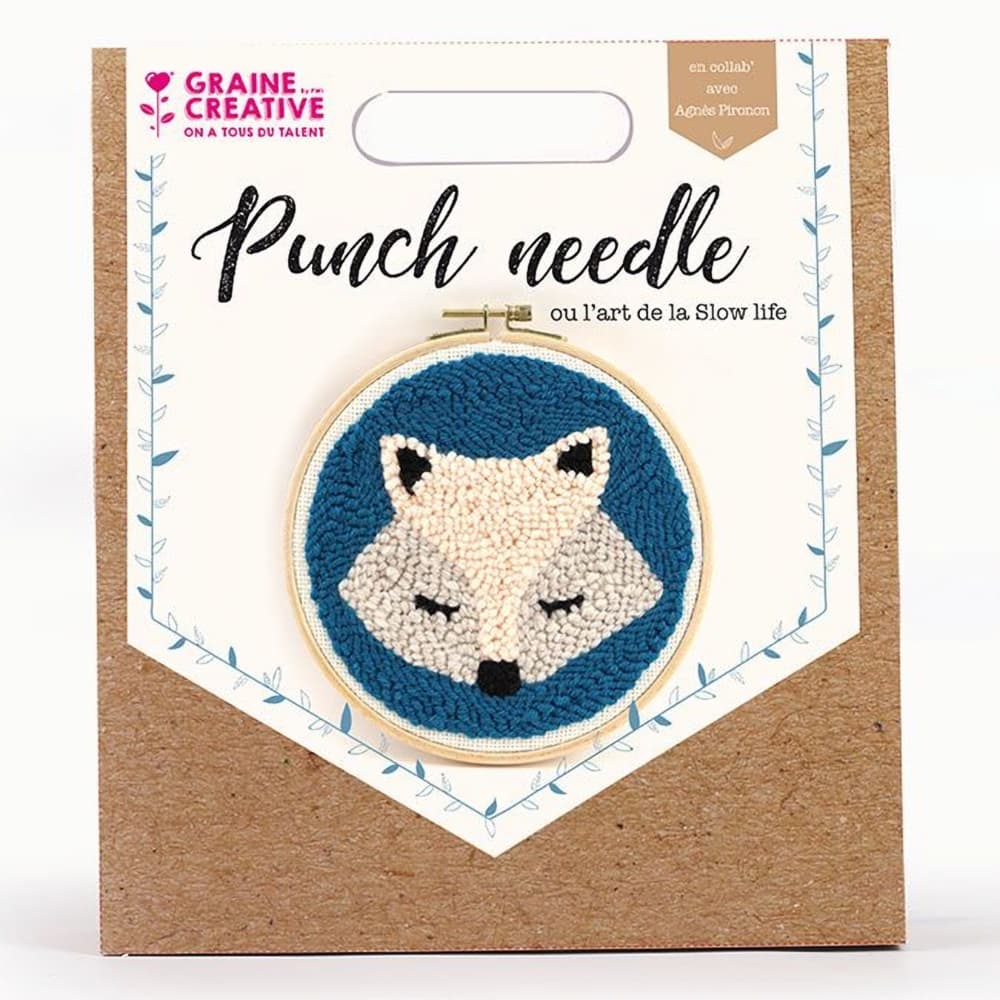
“Punch needle” names two tools that don't do the same job. Our kits contain one or the other, never both.
What they share stops at the principle: a hollow tube, yarn running through it, a bevelled point that goes through the cloth. The bore of that tube changes everything.
The fine needle, around 2 mm
This is the one in the Graine Créative kits. It takes embroidery floss — fine thread sold in short skeins — and gives tight, short loops that can carry a gradient.
It needs a closely woven cloth. Give it thick wool and the yarn packs the tube, stops running, and the loop never forms.
The wide wooden needle
This is the one in the Rico kit. It takes thick wool — their Mega Wool — and produces tall, blunt loops of the kind you read from a metre away.
It needs monk's cloth, whose loose weave lets a fat tube through. On a tight weave it forces, distorts, and eventually tears.
What that means when you buy
As long as you stay with complete kits, the question doesn't arise: the box holds a matched trio — needle, cloth and yarn.
It arises on the second project, when you buy yarn or cloth on its own. That's when the needle stops running and you conclude you learned the movement wrong.
Floss or fine thread
2 mm needle, closely woven cloth
Thick wool
wide wooden needle, monk's cloth
Adjustable needle
sets loop height, not yarn thickness
The setting people mistake for the bore
Many needles adjust. That adjustment changes how far the tube protrudes, so the height of the loop — not the thickness of yarn it will swallow.
A fine needle set to maximum is still a fine needle. It's the most common confusion, and it costs an evening.