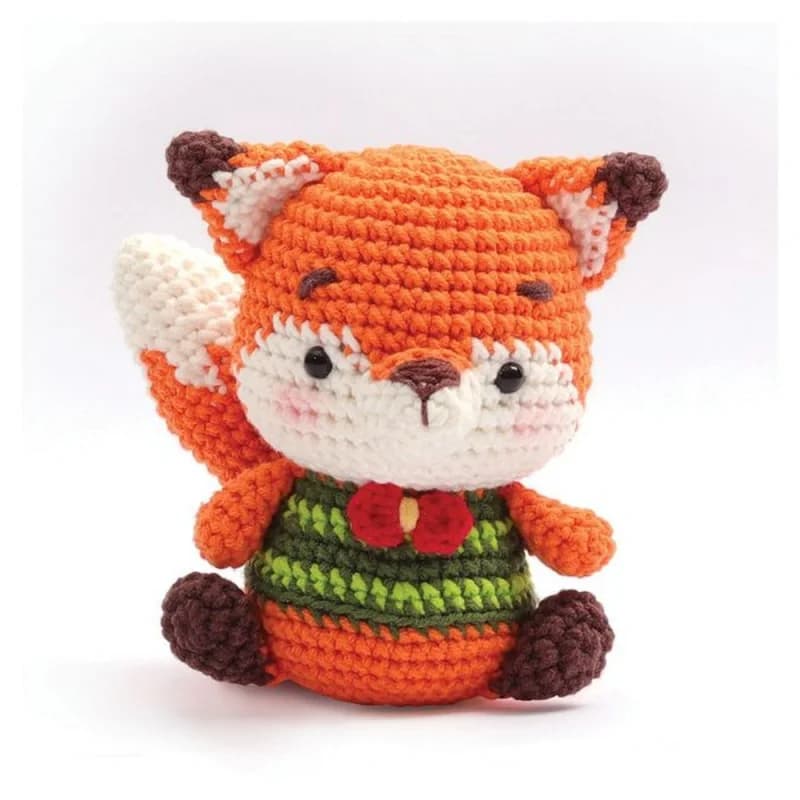
Every ball of cotton carries a recommended hook size on its band. For an amigurumi, go one step below it.
The reason fits in a sentence: an amigurumi is a shell you fill. If the stitches are loose, the stuffing shows through, and the piece looks tired before it is even finished. A smaller hook tightens the fabric and closes the surface.
It is also why your first amigurumi makes your hand ache: you are crocheting tight on purpose, and a beginner adds tension on top of that.
The size, by yarn
Shop-bought amigurumi kits almost all use medium cotton — the equivalent of a 3 to 4 needle yarn. Here is what that means in practice.
Fingering cotton
2 to 2.5 mm hook
Medium cotton — what kits use
2.5 to 3 mm hook
Aran cotton
3.5 to 4 mm hook
Chenille, plush yarn
4 to 5 mm hook
If you only buy one hook
Buy a 3 mm. It covers the large majority of amigurumi kits sold in Europe, and it is the size patterns call for most often.
The handle matters more than you would think. A soft-grip hook changes a two-hour session — which is precisely what most manufacturers put in their boxes.
US sizes, if your pattern comes from elsewhere
Many free patterns are American and give a letter instead of a millimetre. The mapping is not intuitive, and one letter can cover two diameters depending on the maker.
2.25 mm
B/1
2.75 mm
C/2
3 mm
no standard letter — between C/2 and D/3
3.25 mm
D/3
3.5 mm
E/4
4 mm
G/6
What no box tells you
Most product listings don't say. They write "a silicone-grip hook" and stop there — the diameter, never. So even a complete box never tells you what you are holding.
A few are exceptions, and they stand out: DMC's licensed ranges print the size on the back of the box, and some retailers copy it into their list. They are a minority.
You don't notice on the first project, because the tool is supplied. You notice on the second: you want to make the piece again in another colour, you don't know what to buy, and you cannot replace a lost hook with the same one.
It is free information to publish and nobody publishes it. We'll ask the manufacturers.
So, in practice
If you buy a complete kit, the hook is in the box and the question doesn't arise for your first piece.
If you buy a box that doesn't contain one — half of those sold as kits — get a 3 mm with a soft grip. Around €7, to be added to the price on the label.