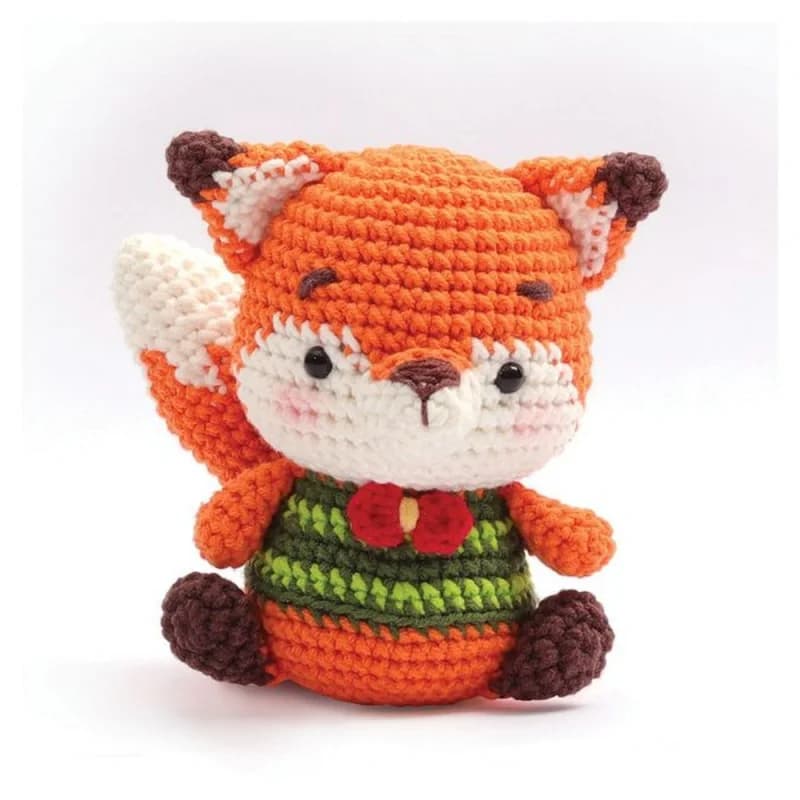
Amigurumi are the small crocheted creatures that came out of Japan. The good news for a beginner: the technique is absurdly small. Where knitting asks you to hold dozens of stitches at once, amigurumi works one at a time.
Six moves are enough. Here is the order to learn them in — it matters, because each one leans on the last.
The six stitches
The chain stitch
Where everything starts. Ten minutes to understand, and you will never relearn it.
The single crochet
Roughly 80% of everything you will do. If you only master one, make it this one.
The magic ring
It lets you begin a round shape without a hole in the middle. The stitch that stops the most beginners, and the one that unlocks the rest.
Increasing
Two stitches into the same stitch. This is what makes a shape grow.
Decreasing
Two stitches worked together. This is what closes a head.
The invisible seam
For joining pieces without it showing. The last step, and the one most often rushed.
The mistake everyone makes
Under-stuffing. An under-stuffed amigurumi sags, and you assume you got the shape wrong — when it is simply short of material. Fill until it is firm under a finger, then add a little more.
The second mistake is quieter: crocheting too tight because you are tense. Your stitches will be too tight and your hand will ache after twenty minutes. That is normal, it comes from beginner tension, and it goes after about two hours of practice. Don't change hook because of it.
Do you need a kit?
For a first object, yes — provided the box holds the tool. Buying separately costs more when you own nothing: a hook is €6.99, safety eyes €3.50, a yarn needle €6.50, stuffing €6.50. That is over €23 before any yarn.
A complete kit at €17.99 therefore beats buying piece by piece, and it saves you choosing sizes you don't know yet. The reverse becomes true by the third or fourth project, once the tools are already on the table.
The trap isn't the kit, it's the incomplete kit — the one holding only yarn and a pattern, whose sticker price means nothing.