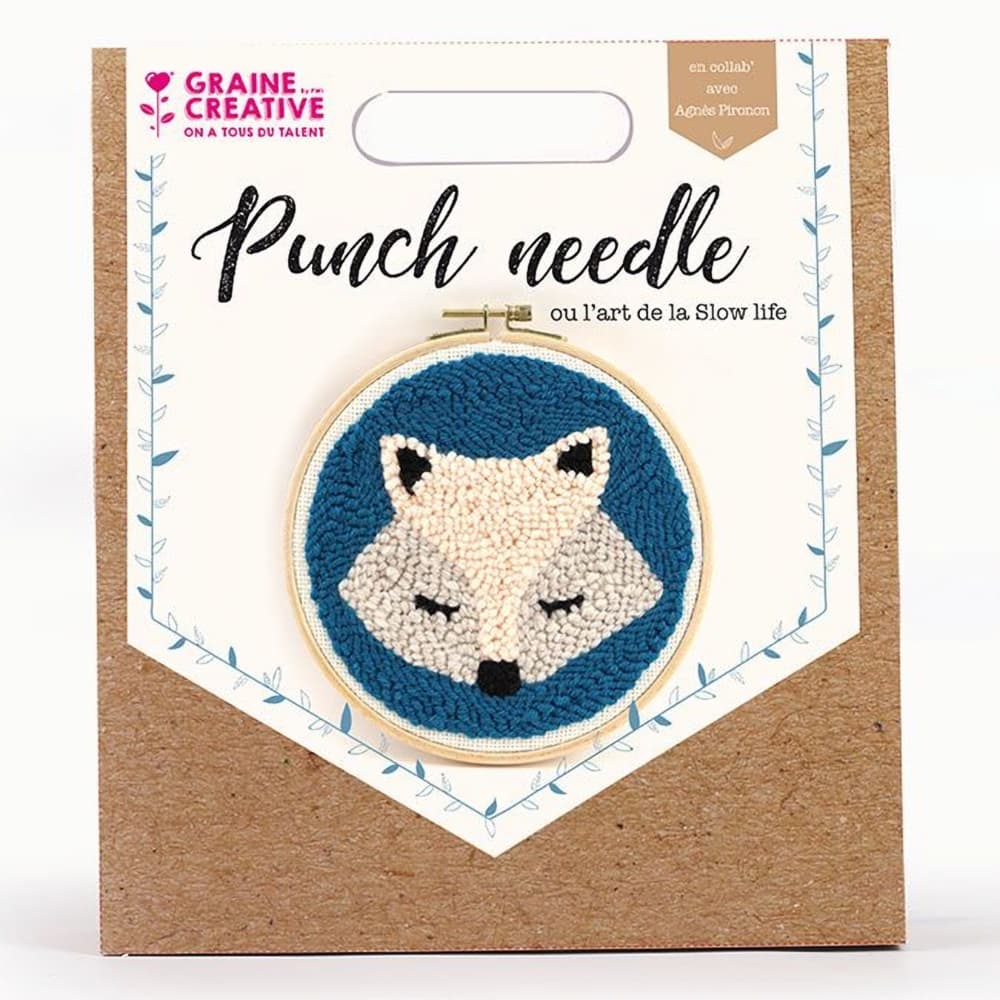
Punch needle knots nothing. The loops hold by friction, packed against each other. That's what makes the craft fast, and it's also what makes it fragile until you've fixed the back.
Pull a loop on an unfixed piece and you undo the row. On a cushion or a tote bag, that happens at the first wash.
What fixes the back
Textile glue brushed across the back, in a thin coat, once the piece is finished and still taut in its hoop. It seeps between the threads and locks the loops without coming through to the front.
The Rico kit includes thirty grams of it. The Graine Créative kits we list don't — their printed cloth is meant to stay in its hoop, on a wall, where nothing rubs.
The question to ask before buying
It isn't “is the kit complete” — they all are, or they wouldn't be here. It's: will the thing I'm making stay on a wall, or will it be handled?
A wall piece needs nothing more. A cushion, a pouch or a bag needs the glue, and possibly a lining stitched over it.
Stays on the wall
the hoop is the frame, nothing to add
Gets handled
textile glue on the back, essential
Gets washed
glue, then a stitched lining
The hoop as a frame
It's the simplest finish and nobody presents it as one: leave the piece in its hoop, trim the cloth to two centimetres, fold it back and gather it with thread behind.
The piece is finished, framed, ready to hang. The hoop in the box was never a tool to put away — it was the frame.